
Short answer: A color run is a short walk, jog or run where volunteers dust participants with colored powder at stations along the course. Participants usually wear white so the color shows. Schools and community groups run them as fundraisers and celebrations. Organizing one takes written approval for the powder, a course with three to five stations, about one volunteer for every eight to ten participants, a budget for powder and cleanup, and a powder-free option.
A color run looks simple from the sidelines: kids in white shirts, clouds of color, a lot of laughing. Behind it is an event with more moving parts than a walk-a-thon, mostly because of the powder. This guide explains how a color run works and walks through every part of organizing one, from the first approval to the last swept tarp. Each section links to a detailed page and to the free tools that do the math. For the money side, see the color run fundraising guide.
What a color run is
A color run is a fun run, walk or obstacle course in which participants pass through color stations where volunteers dust them with colored powder. By the finish, white shirts are covered in color. It isn't a race. Most events don't time anyone, and walking is as welcome as running.
The idea of throwing colored powder comes from Holi, the Hindu spring festival of colors. Large commercial color races spread the format in the 2010s, and schools, parent groups and charities adopted it for their own events. One company holds a trademark on its race name, which is why this site uses "color run" only as a general description of the format. (In the UK and Australia it is a "colour run".) If you plan to print a name on shirts, read the naming notes in our color run themes and name ideas.
The powder is usually a dyed starch, most often cornstarch. It is fun, photogenic and messy. It is also why a color run needs more planning than a walk-a-thon: the powder needs approval, it can irritate eyes and breathing, it burns if a dense cloud meets a flame, and it has to be cleaned up properly.
How a color run works
- Participants arrive in white or light shirts and eye protection, often sunglasses. Many groups start them in waves so stations never face a crowd.
- They walk or run the course, a loop of the school field or track, or a one-way route through a park.
- At each color station, volunteers dust them from squeeze bottles or by hand, aiming below the shoulders. Each station usually has its own color.
- A powder-free route runs alongside, for anyone who prefers no color: same course, same finish, same celebration.
- Some events end with a finale, a group countdown and toss of color packets in an open space.
- Participants dust off before going indoors or to cars, and the cleanup crew sweeps the dry powder up before anyone leaves.
When the color run is a fundraiser, participants ask family and friends to support them, by a flat gift or a pledge per lap, before the event. Community events often charge an entry fee instead. Local businesses sponsor stations.
Common formats
| Format | How it works | Good for | Watch for |
|---|---|---|---|
| School-day loop | Classes or grades take turns on a loop of the field or blacktop; color on one lap | Elementary schools; every student takes part | Getting students clean enough to go back indoors |
| Evening family event | After school or on a weekend; families run together; food and music | PTAs that want a community night and add-on sales | Turnout depends on the date; food sells out |
| Community 5K or mile | A one-way route with stations every kilometer or so; open registration | Churches, nonprofits, high school clubs | Permits, waivers, traffic and street cleanup |
| Obstacle color run | A course with obstacles between color stations | Middle schools and older students | Obstacle safety on powdery, slippery ground |
| Color for one grade | Everyone runs; only one grade, often the oldest, gets color | Schools unsure about powder for young children | Making the other grades' finish feel special too |
| Color plus water | Water spray or a slide at the finish | Warm days | Wet powder stains and runs toward drains |
Many school color runs are really fun runs with color. The color run vs. fun run comparison helps you decide whether the powder is worth it, and the ideas and themes page has dozens of variations. If your school counts laps for pledges, read whether a jog-a-thon or a color run fits better; it explains why powder and lap counting don't mix well.
School vs. community color runs
| School color run | Community color run | |
|---|---|---|
| Participants | Enrolled students, sometimes families | Anyone who registers |
| Money | Flat gifts or per-lap pledges; no student entry fee | Entry fees, plus pledges and sponsors |
| Approvals | Principal, facilities, nurse, sometimes the district | Venue owner, city or park permit, sometimes the fire department |
| Insurance and forms | School or PTA coverage; permission or opt-out slips | Event insurance; the waiver your insurer or venue requires |
| Registration | Usually not needed | Needed: names, ages, emergency contacts, shirt sizes |
| Volunteers | Parents and staff; older students | Members, sponsors' staff, service clubs |
| Cleanup | On school grounds, with custodial staff | Often on public land, sometimes with a deposit |
The school color run guide covers grade-by-grade plans and the school-day schedule. The guide for churches and nonprofits covers public events.
The seven decisions that shape everything
Make these in order. Each one constrains the next.
- Is powder allowed here? Get written approval from the principal or venue owner and facilities, including which surfaces and what cleanup they expect. Nothing else matters until you have it.
- Who is it for? Students only, families, or the public. This sets the money model, insurance and registration.
- When, and when if it rains? Pick the date and the rain date together.
- What format? A loop or a route, how many stations, color on every lap or one.
- How will money come in? Flat gifts, per-lap pledges, entry fees, sponsors.
- Which powder? Get quotes and the Safety Data Sheet before you order.
- Who leads? A chair, a treasurer, a safety lead, a course lead and a volunteer lead, at minimum.
The step-by-step color run plan turns these into a full sequence with owners and common mistakes.
Color powder and supplies
Most color run powder is cornstarch or wheat starch with synthetic dyes. Ask every supplier for the full Safety Data Sheet, the base starch (wheat-based powders contain gluten) and the dye list for each color. How much you need depends on stations, laps with color, how volunteers apply it and whether there is a finale.
Arithmetic 400 participants × 4 stations × 50 g per dusting = 80 kg, plus a 15% buffer = 92 kg, about 203 lb. In our price check of four sellers on October 20, 2026, powder in bags of 5 lb or more listed at about $3.20 to $6.40 a pound depending on quantity.
Beyond powder you need squeeze bottles or scoops, bins, tarps under every station, eye protection, water and cups, first aid supplies, cones and signs, and cleanup gear. The color powder and supply guide has the full list and explains why published powder advice disagrees by roughly tenfold or more. The course and station planner calculates your powder order.
Course and color stations
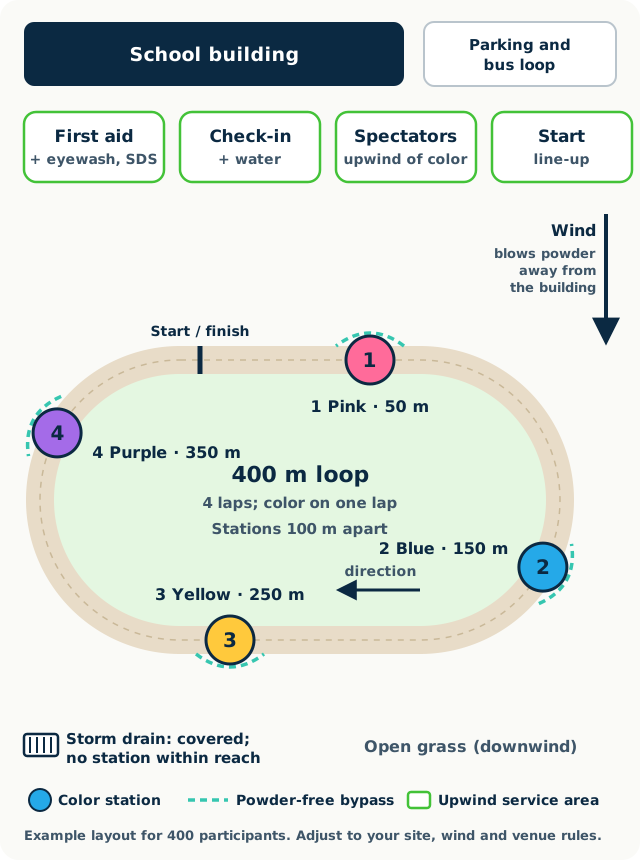
A school loop of 400 m with four stations, 100 m apart, works well for an elementary school. A community route can be a mile or a 5K with a station roughly every kilometer. Three to five stations is common. Fewer stations close together make one long cloud; spread them out.
- Surface. Grass is easiest to clean. Blacktop sweeps well. Powder can stain running tracks, and many artificial turf fields ban staining substances, so ask first.
- Wind. Place stations so powder blows away from buildings, parked cars, spectators and the first aid table.
- Drains and water. Keep stations away from storm drains, and at least 100 feet from streams where Washington State's color event rules apply. Cover nearby drains.
- Station layout. A tarp under the station, bins of powder behind the applicators, a lead who can see the lane, and a bypass for the powder-free route.
The course and color station guide covers layouts, dispensing methods and the finale zone.
Safety and accessibility
No color powder is proven safe for everyone. It can irritate eyes and airways, trigger asthma or dye allergies, and burn as a flash fire if a dense cloud meets a flame or hot light. In 2015, powder sprayed over a party crowd in Taiwan ignited, and 15 people died. A school color run is far smaller and simpler, but the same rules apply at every scale:
- Color below the shoulders, never at faces, and stop for anyone who says stop.
- No flames, smoking, grills, sparklers, fireworks or gas-powered equipment near powder. Never indoors or in tents.
- Eye protection for everyone, and glasses rather than contact lenses.
- A first aid table with eyewash, the Safety Data Sheet and students' medications.
- A powder-free route that is a full version of the event, chosen privately.
The color powder safety guide explains each risk with sources from fire marshals, health agencies and medical authorities. The inclusive and powder-free options page covers asthma, allergies, sensory needs, mobility and cost barriers, so every participant can take part.
Participants, volunteers and spectators
Participants need to know what to wear (a white or light shirt, closed shoes, sunglasses), what the powder is, and how to choose the powder-free route. The family notice covers it in one page.
Volunteers run the event. A 400-participant school color run with four stations needs about 44: a lead, a refill runner and four applicators at each station, plus start and finish, water, first aid, a powder-free route guide, course marshals, cleanup and lap counters if you pledge per lap. That is roughly one volunteer for every eight to ten participants. Fill leads and safety roles first. The color run volunteer guide has role descriptions and a briefing script.
Spectators want to watch, photograph and sometimes join the finale. Give them a viewing area upwind of the stations, and tell them that powder drifts.
- Family noticeWhat to expect, what to wear, and a private powder-free request slip.Download PDF
- Volunteer cardsSix role cards with the station rules.Download PDF
Costs and budget
A color run costs more than a walk-a-thon because so much is bought per participant. Example For a 400-participant school event with four stations, a budget of about $2,700 covers roughly 203 lb of powder ($880), station supplies, eye protection for everyone, water, first aid, signs, recognition, printing and cleanup, with a 10% contingency. Replace every line with your own quotes.
Documented events show the range. A Virginia PTO reported costs of about $6,000, including shirts, against $25,010.50 raised. A Florida PTO reported $60,000 raised with $50,000 profit. The color run cost and budget guide itemizes the example and explains what drives costs up, and the budget worksheet builds yours.
Promotion and registration
For a school, promotion means making sure every family knows the date, what to wear, how giving works and how to choose the powder-free route. Send the family letter about four weeks before the event, hold a kickoff three weeks out, share a midpoint update and send a final reminder two days before.
For a community event, registration does the heavy lifting. Open it eight to ten weeks ahead, collect only what you need (name, age group, emergency contact, shirt size, route choice), use the waiver your insurer or venue requires, and sell as many entries as you can before you order powder. The guide to promoting a color run includes the flyer and registration templates.
- FlyerFill-in flyer with the powder-free line.Download PDF
- Registration formRoute choice, health notes, emergency contact, space for your required waiver.Download PDF
Event-day flow
| When | What happens |
|---|---|
| Three hours before | Setup: cones, tarps, signs, water and first aid |
| Two hours before | Sealed powder to each station's refill zone; bottles filled before the first wave |
| Ninety to seventy-five minutes before | Volunteer check-in, cards and the ten-minute safety briefing |
| One hour before | Go/delay check on wind, heat and lightning |
| Thirty minutes before | Classes line up by wave; powder-free participants meet their lane guide |
| Ten minutes before | A short welcome, kept under five minutes |
| Start | First wave; the other waves follow six minutes apart while leads watch wind and the powder-free route |
| After the last wave | Finale, if planned; everyone dusts off before going indoors |
| Until about two hours after the start | Dry cleanup at every station and a walk-through with facilities |
| Same day | Envelopes to the treasurer; two people count |
Times in the table count back from the first wave, so write your real start time at the top of the printed schedule and fill in the rest from it. Name one person who makes every go, delay and stop call, with the safety lead beside them. Three stop rules cover most days: thunder or lightning stops everything and sends people indoors; wind carrying powder toward buildings, cars or spectators pauses that station; rain or a soaked field moves you to the rain date. On a hot day, run fewer laps, put water at the end of every lap and send the youngest waves first. Give each station lead a printed copy so nobody has to find you to ask.
The color run event-day plan has full run-of-show templates for a school day and an evening event, plus the stop rules.
Cleanup and the environment
Clean up dry first. Water turns powder into a colored paste that stains concrete and runs into storm drains, and under federal stormwater rules a discharge to a storm drain that isn't entirely stormwater is generally an illicit discharge. Sweep dry powder onto tarps without leaf blowers, bag it as trash, and walk the site with facilities before anyone goes home. Some cities set strict conditions for large color runs: City of Lawrence, Kansas, staff recommended a $20,000 deposit, refundable only if permit conditions were met, for a 5K color run after the previous year's cleanup was less thorough than staff expected (City of Lawrence memo, 2013). The color run cleanup guide covers every surface, and how families get powder out of clothes, hair and cars.
The planning sequence
Eight weeks is the recommended window for a school color run; six is the minimum. Community events with permits or registration need ten to twelve.
| Weeks out | Focus |
|---|---|
| 8+ | Written approval, date and rain date, goal and giving model |
| 6–7 | Quotes and SDS, budget, sponsor requests, volunteer sign-up, course map |
| 4–5 | Registration checkpoint for community events, then order powder and supplies; send the family letter and powder notice |
| 2–3 | Kickoff, health review with the nurse, midpoint update |
| Final week | Volunteer briefing, weather call, final reminder, setup |
| After | Giving deadline, thank-yous, reconcile, debrief |
The color run planning timeline dates every step from your event date and exports it to your calendar. The printable checklist puts it on one page. Answers to dozens of quick questions are on the color run questions page.
- Planning checklistEvery task by phase, from approval to debrief.Download PDF
- Event-day scheduleRun-of-show template with the stop rules.Download PDF
Deciding between a color run and a walking event? Our walk-a-thon guide covers the simpler option, and the walk-a-thon vs. color run comparison puts them side by side.
Sources
- City of Lawrence, Kansas, Color run memo (2013). assets.lawrenceks.gov (accessed October 20, 2026)
Frequently asked questions
Do you have to run in a color run?
No. Most color runs are untimed, and walking is as welcome as running. School events often have students walk the course with their class. Make that clear in every announcement, because some families assume a "run" isn't for them. Strollers and wheelchairs need a smooth surface and a route around obstacles, so plan for them.
Do we need an event company to run a color run?
No. Schools, PTAs, churches and community nonprofits run color runs themselves with volunteers, powder bought from a supplier and their own way of collecting gifts. Some event companies will run one for you in exchange for a share of what you raise. If you consider one, get the percentage, what it is calculated on and what it covers in writing. Our PTA and PTO guide compares the two options side by side.
Is a color run worth the extra cost compared with a plain fun run?
Only if the color brings in more giving than it costs. In our example for a 400-student school, the color run costs about $2,700 and a plain fun run about $1,060. The color has to raise about $1,700 more in gifts to break even, roughly 68 extra $25 gifts. A sponsor who covers the powder changes that math. Our color run vs. fun run comparison works through all three scenarios.
What age is a color run for?
Any age, with adjustments. Many schools run color runs from kindergarten up, with a lighter dusting, color only at the finish, or no finale toss for the youngest students. Others keep color for older grades only. Children under five should be with an adult. Talk with your nurse and offer the powder-free route at every age.