
Short answer: A 400-participant school color run with four stations needs about 44 volunteers with flat gifts, or 48 if you count laps for per-lap pledges. Each station takes a lead, a refill runner and four applicators. Add marshals, water, first aid, a powder-free lane guide and a cleanup crew. Recruit station leads and first aid first, ask for fixed shifts, and give everyone a 10-minute safety briefing.
A color run needs more volunteers than a plain walk, because every color station needs its own small team and the cleanup is a real job. For the sign-up sheet itself and reminder messages, our walk-a-thon volunteer sign-up guide works the same way for a color run.
How many volunteers you need
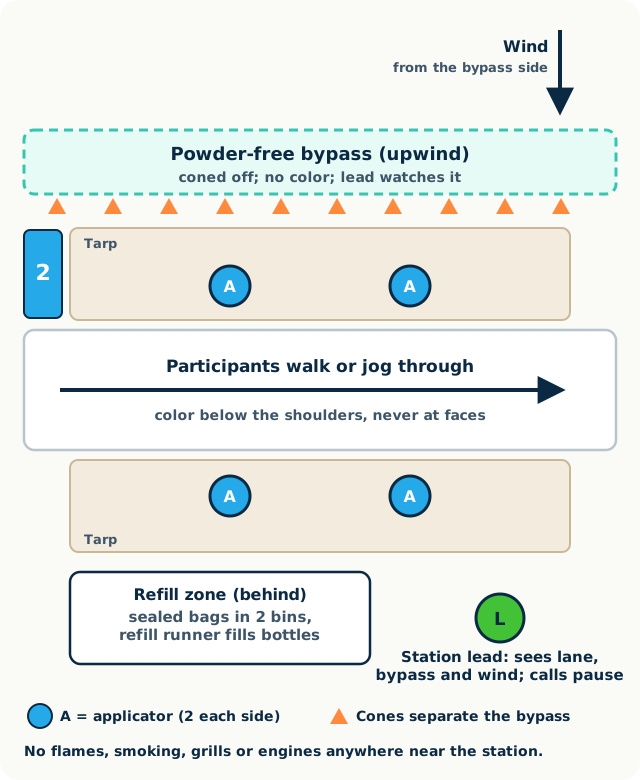
For the example event we use across this section, the course and station planner calls for 44 volunteers with flat gifts, or 48 if you count laps for per-lap pledges. The example is a 400-participant school color run on a 400-meter loop, with four laps, four stations and two applicators on each side of every station.
| Role | Count | How the planner sets it |
|---|---|---|
| Station leads | 4 | One per station |
| Applicators | 16 | Stations × sides × applicators per side: 4 × 2 × 2 |
| Refill runners | 4 | One per station |
| Start and wave marshals | 2 | Fixed |
| Finish and water | 3 | One per 150 participants, at least 2 |
| First aid and eyewash | 2 | One adult with first aid training, plus a second over 300 participants |
| Powder-free lane guide | 1 | At least one |
| Course marshals | 4 | Two per kilometer of total distance, at least 2 |
| Cleanup crew | 8 | Two per station, at least 4 |
| Lap counters | 0 (4 if per lap) | Only if pledges are per lap: one per 25 participants in a wave |
| Total | 44 | 48 with lap counters |
Arithmetic Station teams: 4 leads + 16 applicators + 4 refill runners = 24. Everyone else, with flat gifts: 2 + 3 + 2 + 1 + 4 + 8 = 20. Total 24 + 20 = 44, or 48 with four lap counters for per-lap pledges.
Count people, not shifts, for the station teams. They work the whole color window. Other roles can be split. Some setup volunteers can stay on as cleanup crew, but recruit the cleanup crew separately anyway. Teardown is the shift most often left short. Acme School Council in Alberta noted in its June 2024 minutes, before its run, that it could use a couple more volunteers for teardown.
Your count will differ. Fewer stations, applicators on one side only, or a shorter course all bring it down. Enter your own numbers in the planner.
Who to recruit first
Recruit in this order, starting about six weeks out:
- Station leads and first aid. Ask people directly, one by one, before any public sign-up opens. Station leads recruit and brief their own applicators. First aid needs an adult with current training, ideally the school nurse or someone the nurse recommends.
- The powder-free lane guide and the cleanup lead. Both need judgment and should be people you trust.
- Applicators, refill runners, marshals, water and cleanup crew. Open the public sign-up with each role described in one line and a fixed time block.
Ask for a specific shift, not open-ended help. Oquirrh Elementary PTA in Utah planned on about 21 volunteers for its 2025 color run, then noted it needed more volunteers and that a parent-teacher conference at the high school may have had an impact. Its October 2025 minutes list the fixes for next year, including a dedicated powder-refill volunteer and shift-based asks such as "Please help for 30 minutes." Check the calendar for clashes with high-school events, sports and church commitments before you set the date.
Look beyond parents. High-school honor societies, service clubs and sports teams often need service hours. At Waldron Elementary in Indiana, high school National Honor Society students volunteered at the first color run. Church youth groups are a good source, too. At St. Mary's Parish in Bloomfield, New Mexico, 30 teens worked the event for its youth group's first color run.
What each role does
These match our printable volunteer cards. Hand each volunteer the card for their role at check-in.
Station lead
Owns one station from setup to cleanup. Briefs the station's applicators before the first wave, watches the wind and the powder-free lane, and calls pause and restart. Keeps powder bags sealed in the bin until the refill runner opens one. Reports anyone who needs first aid and sends a buddy with them.
Applicator
Dusts shirts and legs as participants pass, with a gentle toss or squeeze, not a throw. Stands still and lets participants come to them. Watches for the powder-free lane and for anyone saying stop. Wears the eye protection and mask provided.
Refill runner
Refills bottles and bins from sealed bags, low and away from the lane, and closes every bag after each refill. Keeps bags off wet ground. Tells the lead when the station is down to half and to a quarter, and carries empty bags to the trash.
Powder-free lane guide
Walks or stands with powder-free participants at each station and raises the agreed signal so applicators lower their bottles. Never makes a participant explain why they chose the lane. If color lands on someone by accident, apologizes and helps them brush it off.
First aid and eyewash
Sets up upwind of every station with clean water, eyewash and the powder's Safety Data Sheet. For powder in the eyes, flushes with clean, lukewarm water for at least 15 minutes, or as long as the SDS says, and follows the SDS and their first aid training. Moves anyone with breathing trouble away from the powder into fresh air and follows their action plan or calls for help. Watches for heat illness and records what happened.
Cleanup crew
Starts after the last wave leaves each station. Sweeps dry powder onto the tarps and bags it as trash. Sweep dry first. No hoses or pressure washers on paving unless all the water is collected for the sanitary sewer, with approval. Checks doors, windows, vehicles and equipment near each station, then walks the site with facilities. Our cleanup guide has the full method.
Marshals, water and lap counters
Start and wave marshals line up each wave and release it on time. Course marshals stand at turns and crossings and keep spectators off the course. Water volunteers pour and hand out cups past the finish. Lap counters, if you need them, mark laps for one group of participants each. Our lap counting guide covers the methods.
- Color run volunteer cardsStation lead, applicator, refill runner, powder-free lane guide, first aid and cleanup, with the station rules on the lead and applicator cards.Download PDF
The 10-minute safety briefing script
Hold the briefing for all volunteers together after check-in and before participants arrive. The chair or volunteer lead reads it aloud. Keep it to ten minutes so it actually happens, and send the station cards a week ahead so nobody hears the rules for the first time on the day.
Change the names, locations and signal to fit your event. Don't cut any of the safety points, which match the rules on every station card and on our color powder safety page.
Protective gear for volunteers
Volunteers at stations spend far longer in the powder than any participant, so give them eye protection and a dust mask. Budget for one set per volunteer. Sunglasses or safety glasses keep most powder out of the eyes. Close-fitting safety glasses are better than fashion sunglasses for applicators and refill runners. Volunteers who wear contact lenses should switch to glasses for the day.
Masks reduce how much powder a volunteer breathes in, but no mask makes the cloud harmless. A bandana is not a filter. KCRG-TV9's report on color run powder noted that surgical masks won't fully protect against fine particles. Volunteers with asthma or other lung conditions should take a role away from the stations, such as water, marshaling or check-in.
Add gloves for refill runners, hats for hair, and old clothes or a coverall for everyone at a station. Tell volunteers in the sign-up description that they will get colored.
Student volunteers and teachers
Students can do a lot, as long as the role suits their age and an adult is nearby.
| Age | Good roles | Avoid |
|---|---|---|
| Elementary students | Cheering sections, handing out water cups with an adult, carrying signs | Any role at a station; handling powder |
| Middle school | Course marshals with an adult nearby, water, setup and carrying cones | Applicator roles near younger children's faces |
| High school | Applicators, refill runners, marshals, cleanup crew, all with an adult station lead | Station lead, first aid, the weather call, money |
At Sycamore Middle School in Gridley, California, student volunteers ran the stations for the school's annual color run, which supported a cancer foundation. If students apply color, give them the same briefing as adults, put an adult station lead at each station, and keep them away from younger children's faces. Ask your school about service-hour forms and any rules on minors volunteering.
Teachers usually run with their classes and help keep waves in order. Some schools also have teachers apply color. Oquirrh Elementary's PTA planned for teachers to use PTA-supplied powder bottles at its 2024 color run. That works as long as teachers hear the briefing. Teachers never collect, hold or count money. Cash and checks go in sealed envelopes to the office or a locked box the treasurer empties.
Event-day check-in
Set up a check-in table near the start, upwind of the stations, ready when check-in opens 90 minutes before the first wave, 15 minutes before the briefing. Have it ready with:
- A printed roster by role and station, with phone numbers for leads
- Volunteer cards sorted by role, plus spare copies of the station rules
- Eye protection, masks and gloves sorted by role
- Name tags or colored wristbands by role, so participants and leads can tell who is who
- Water and sunscreen for volunteers
- A sign-out sheet for any radios or equipment
Check each volunteer in, hand over their card and gear, and send them to their lead. If your school or district requires volunteer clearance, check it against the roster before the day, not at the table. The event-day schedule has a line for check-in and one for the briefing so leads know where everyone should be.
When you're short-staffed
If sign-ups fall short in the final week, cut color before you cut safety. Every safety role stays filled, whatever the count.
- Never cut: first aid, the powder-free lane guide, the station lead at every station that runs, or the cleanup lead.
- Cut first: a station. Dropping from four to three stations on the example loop saves six station volunteers and two cleanup volunteers, and stations 133 meters apart still work.
- Then: move to applicators on one side only. That saves two volunteers per station.
- Then: drop per-lap pledges for this year and switch to flat gifts, which removes the lap counters.
- Last resort: run the event powder-free or move to the rain date.
Arithmetic On the example event without lap counters, four stations need 44 volunteers. Three stations with applicators on both sides need 36: 3 leads + 12 applicators + 3 refill runners + 18 in other roles, with the cleanup crew down to 6. Three stations with applicators on one side need 30.
If you're also running a walk-a-thon or fun run without powder, the volunteer planner for walk-a-thons sizes those events. For the full sequence of planning tasks, see our guide to organizing a color run. Our walk-a-thon resource library covers the shared basics of running any school walk or run.
Sources
- Acme School Council, School council meeting minutes (Jun 17, 2024). acmeschool.ca (accessed October 20, 2026)
- Oquirrh Elementary PTA, Jordan School District, PTA meeting minutes, September 2025. oquirrh.jordandistrict.org (accessed October 20, 2026)
- Oquirrh Elementary PTA, Jordan School District, PTA meeting minutes, October 2025. oquirrh.jordandistrict.org (accessed October 20, 2026)
- Oquirrh Elementary PTA, Jordan School District, PTA meeting minutes, Aug 9, 2024. oquirrh.jordandistrict.org (accessed October 20, 2026)
- Shelby Eastern Schools, Waldron Elementary first annual color run (Jun 2, 2017). shelbyeastern.org (accessed October 20, 2026)
- Voice in the Desert, Diocese of Gallup, Bloomfield color run funds good causes (Oct 17, 2013). voice.dioceseofgallup.org (accessed October 20, 2026)
- KCRG-TV9, Color Run powder could lead to health concerns (Jul 21, 2016). kcrg.com (accessed October 20, 2026)
- Gridley Herald, Color run off to a bright start (Mar 28, 2024). gridleyherald.com (accessed October 20, 2026)
Frequently asked questions
Do color run volunteers need a background check?
That depends on your school, district or organization, not on the event. Many districts require approved volunteer status for anyone working with students during the school day, and some require it only for unsupervised roles. Ask the front office early, because clearances can take weeks to process. Build the roster from cleared volunteers first, and put anyone still waiting in roles away from students, such as setup or cleanup.
How do we thank color run volunteers?
Send a short personal note within about ten days that says what the event raised and what it will buy. Name the volunteers in a newsletter or at the next meeting, by role rather than ranked by hours. Small things on the day help, too: water, shade, a snack and a clean towel at the end. Our thank-you letter set includes a volunteer note you can adapt.
Can a parent volunteer and still watch their own child run?
Yes, if you plan for it. Station volunteers stay in place through every wave, so a parent applicator will see their child pass. Parents who want to run alongside a young child can take a shift that ends before that wave, such as setup or check-in. Ask about this on the sign-up form, so you can place parents around their child's wave instead of losing them at the last minute.
How should volunteers dress for a color run?
Old clothes they don't mind staining, closed shoes with grip, a hat or bandana over their hair, and the eye protection you provide. Long sleeves help station volunteers keep powder off their skin. Suggest leaving phones in a sealed zip bag or with a friend, because powder gets into ports and cases. Remind volunteers to bring a change of clothes and an old towel for the car seat.