
Short answer: Set up three hours before the first wave, brief volunteers about 75 minutes before, and check wind, heat and lightning an hour out. For a 400-student school event, four waves of 100 started six minutes apart finish in about 35 minutes. Plan 45. Then run the finale if you have one, dust everyone off outdoors, clean up dry, and send money to the treasurer in sealed envelopes.
This page covers the day itself, from the setup crew's arrival to the moment the treasurer locks the cash box. It gives you a run of show for a school-day event and one for an evening community event, the rules for pausing or stopping, and the logistics of getting 400 students back indoors clean. The times are relative to the first wave's start (T), so you can fill in your own clock times on the printable schedule.
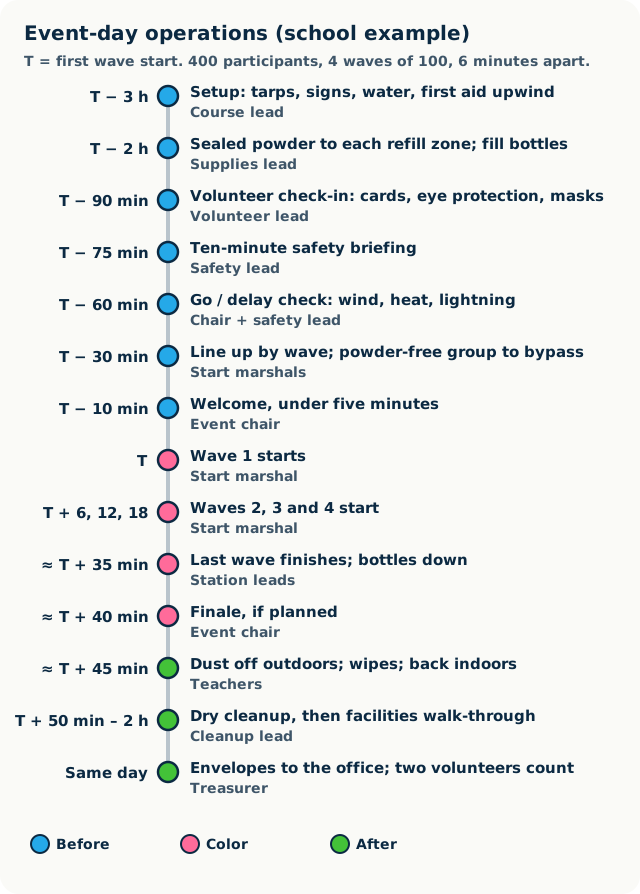
Sample run of show: a school-day event
This schedule fits the example event used across this guide: 400 students on a 400-meter loop, four laps each, color on one lap, four color stations staffed on both sides. The course and station planner's defaults put participants in four waves of 100, started six minutes apart.
Arithmetic 400 participants ÷ 100 per wave = 4 waves. Three gaps × 6 minutes = 18 minutes until the last wave starts. Four laps × 400 m = 1.6 km. At the planner's default pace of 10 minutes per kilometer, that takes about 16 minutes. The last wave finishes about 18 + 16 = 34 minutes after the first wave starts. Plan on 45 minutes of course time so slower walkers and a short pause don't push the whole day late.
| When | What happens | Owner |
|---|---|---|
| Day before | Mark the course with cones. Stage tarps, bins and signs. Powder stays sealed in dry storage. Recheck the forecast against the weather call you made three days out. | Course lead, supplies lead |
| T − 3 hours | Setup crew arrives. Tarps go down at each station, signs go up, and water and the first aid table are set upwind of the stations. | Course lead |
| T − 2 hours | Sealed powder moves to each station's refill zone, behind the applicators. Fill every bottle or cup before the first wave. | Supplies lead, refill runners |
| T − 90 minutes | Volunteer check-in. Hand out role cards, eye protection and dust masks. | Volunteer lead |
| T − 75 minutes | Ten-minute safety briefing for every volunteer, including teachers who will apply color. | Safety lead |
| T − 60 minutes | Go/delay check: wind direction, heat, lightning in the forecast. Move or drop any station the wind would blow toward a building, parking or spectators. | Event chair, safety lead |
| T − 30 minutes | Classes line up by wave. Powder-free participants meet their lane guide. Phones go into zip bags. | Start marshals, teachers |
| T − 10 minutes | Welcome and how it works, kept under five minutes. | Event chair |
| T | Wave 1 starts. | Start marshal |
| T + 6, 12, 18 minutes | Waves 2, 3 and 4 start. | Start marshal |
| About T + 35 minutes | Last wave finishes. Applicators lower their bottles. | Station leads |
| About T + 40 minutes | Finale, if you planned one. | Event chair |
| About T + 45 minutes | Dust-off, wipes and a class-by-class return indoors. | Teachers, finish crew |
| T + 50 minutes to T + 2 hours | Dry cleanup at every station, then a walk-through with facilities. | Cleanup lead |
| Same day | Envelopes and forms go to the treasurer. Two people count. | Treasurer |
Real schools have used tighter or looser spacing. Remuera Primary School in Auckland published a schedule that started a race for each year group roughly every 10 minutes, followed by an older-siblings and teachers race and a closing color burst. Grade-by-grade waves are easier for teachers. Mixed waves are shorter overall. Either works if the start marshal holds each wave until the one ahead has cleared the first station.
Sample run of show: an evening community event
A community event adds registration, waivers, spectators and usually food. Keep the color portion in daylight: dusk makes it hard for applicators to see faces and for marshals to see the course.
| When | What happens |
|---|---|
| T − 3 hours | Setup as above, plus a registration tent, a spectator area upwind of the stations, and food vendors well away from powder. |
| T − 90 minutes | Registration and check-in open. Confirm each participant's form, including the waiver your venue or insurer requires. Hand out wristbands or bibs. |
| T − 75 minutes | Volunteer briefing. |
| T − 45 minutes | Go/delay check. Close same-day registration at a set time so the start marshal knows the headcount. |
| T − 15 minutes | Warm-up and welcome. Say where the powder-free route starts and where first aid is. |
| T | First wave. Run a quieter sensory wave or a youngest-children wave first, while the course is cleanest. |
| T + 30 to 60 minutes | Remaining waves, then the finale if planned. |
| After the last wave | Dust-off, food, music. Cleanup starts at each station as soon as its last wave passes. |
Mokena School District 159's PTA, for example, ran a sensory dash, a kids' dash and a 5K, followed by a DJ and food trucks, at an event Patch reported was estimated to have raised $13,000. Oquirrh Elementary's PTA in Utah planned food trucks to lengthen the evening after the run.
Go, delay and stop rules
Decide these before the day and print them on the schedule. One named person makes the call, with the safety lead's advice. Three days out, set the hour you will make the go, delay or rain-date call and how families will hear it. On the day, check again an hour before the start.
| Condition | Call | What to do |
|---|---|---|
| Thunder heard or lightning seen | Stop | Color stops at once and everyone moves into a sturdy building or a hard-topped vehicle. The National Weather Service advises sheltering as soon as you hear thunder and waiting at least 30 minutes after the last thunder before going back out. If your district or venue has a stricter lightning policy, follow it. |
| Wind carrying powder toward buildings, cars or spectators | Pause that station | The station lead pauses color. Move the station, turn applicators to face downwind, or let waves pass that station without color. |
| Strong gusts across the whole site | Delay or reduce | Color at one downwind station only, or run the course powder-free and save the color for a calmer rain date. |
| Hot day | Go with changes | Fewer laps, water at the finish of every lap, shade at the start line, and the youngest waves first while it is cooler. The American Academy of Pediatrics treats a heat index of 90 °F as a reason for caution and 105 °F or higher as a danger day (HealthyChildren.org). Our own rule, stricter than the AAP's advice to limit time outside: at a heat index of 105 °F or higher, move to the rain date. |
| Rain or a soaked field | Delay | Wet powder turns to paste and stains. Move to the rain date. |
| Crowding at a station, or anyone in distress | Pause | The start marshal holds the next wave until the lead restarts. |
Two documented events show the range. On a 40+ degree (Celsius, about 104 °F) day, the local fire brigade at Hunter River High School in New South Wales hosed students with cool water as they completed each lap. In New Jersey, Howell's color run was postponed twice in a row because the fields had not dried out from constant rain. Pick the rain date when you pick the date, and say it in every message to families.
Communication on the day
Settle who talks to whom before the first volunteer arrives. Phones are enough for a school field if the right people carry them and everyone knows the numbers.
- Who carries a phone. The chair, the safety lead, the first aid lead and every station lead, each charged and kept in a zip bag. Applicators don't need one.
- A printed contact sheet. One page listing the chair, safety lead, first aid, each station lead, facilities and the school or venue office, with the site address at the top. Put a copy at every station, at the first aid table and in the chair's box. Phones get powder in them, so paper is the backup.
- One stop signal everyone can see. Pick a signal and teach it at the briefing, for example the station lead raises both arms and blows a whistle. Every applicator stops at once, and the start marshal holds the next wave until the chair restarts.
- Who calls 911. Name one person, usually the first aid lead, to make the call and stay with the patient. Name a second person, such as the facilities contact or office staff, to meet responders at the entrance and walk them to the spot. Write both names on the contact sheet.
- How families hear about delays. Use the channel you set three days out, usually the school's message app, with one person sending. Post the same message at check-in so families on site hear it too.
Station rules for the day
Every station lead and applicator gets these rules on a card and hears them at the briefing. Our volunteer guide has the full briefing script.
- Apply color below the shoulders. Never at faces.
- Stop for anyone who says stop, covers their face or turns away.
- Nobody in the powder-free lane gets color.
- Pause when wind carries powder toward buildings, cars or spectators.
- No flames, smoking, grills, sparklers, fireworks or gas-powered equipment anywhere near powder. Keep bags sealed, dry and away from heat until a refill runner opens one.
- Powder in someone's eyes: walk them to first aid to rinse with clean water.
For why these rules exist and what the evidence says about breathing, eyes and combustible dust, read our color powder safety guide. Your local fire, health and venue authorities have the final word.
Running the waves
The start marshal controls the whole event's pace. A good wave plan does three things. It keeps clouds from neighboring stations from merging, it stops crowds forming at a station, and it lets every class finish in its block of time.
- Size waves by station capacity, not by class size alone. If a station can't dust a wave without people stopping in the cloud, the wave is too big.
- Hold the next wave until the one ahead has cleared the first station.
- Put powder-free participants in every wave on the same course. At every station they take the coned bypass on the upwind side, so applicators never have to pick them out of a crowd, and each station lead watches the bypass. The lane guide moves between stations and walks with any participant who wants company. They should not wait for a separate slot at the end unless their family asked for one.
- Let siblings run together if families ask. Oquirrh Elementary lined students up alphabetically so siblings could run together.
- Count laps only if pledges are per lap. Flat gifts don't need lap counters. Per-lap pledges add four volunteers to the example plan.
Keep a refill runner moving at every station. Oquirrh's PTA noted afterward that it needed a designated job of refilling powder bottles during the run, along with wide-mouth funnels and more bottles filled in advance.
The finale
A group color toss at the end is optional. If you hold one, run it in an open area away from buildings, cars and the spectator area. Have everyone face away from the wind. Hand out packets only at the countdown, not while people are waiting. Do not use cannons or powered launchers: the Massachusetts State Fire Marshal's 2016 memo tells fire departments not to allow projection of colored powders over a crowd through cannons or other powered means.
Give powder-free participants a real role. They can stand upwind on the stage side and lead the countdown. Students whose families checked "skip the finale" on the family notice can join them. For K–2 students, many schools skip the finale entirely and let the stations be enough.
The dust-off station
Set a dust-off area on grass past the finish, away from building doors, storm drains and the food area. Students shake out shirts, stamp their feet and brush their arms with a towel or soft brush. Close eyes and mouth, and brush from the shoulders down.
Some schools use leaf blowers here. Oquirrh's PTA collected six leaf blowers to help blow off chalk; the minutes don't say whether they were gas or electric. That distinction matters. A Tennessee fire official warned that gas-powered leaf blowers seen at some races could provide a spark. We recommend no blowers at all. The Massachusetts State Fire Marshal advises keeping electrical and gas-powered equipment out of powder zones, and a blower aimed at a child puts powder in the air at face height. Have participants shake off and brush down with towels instead, on grass away from drains. Brushes and towels do most of the work without the risk.
The first aid table
Place first aid upwind of every station, with shade. Staff it with an adult trained in first aid; ask the school nurse first. Stock it with:
- Clean water and eyewash bottles for rinsing eyes
- A printed copy of your supplier's Safety Data Sheet (SDS)
- Students' asthma action plans and relievers, collected by the nurse
- Wet wipes, towels, ice packs, gloves and a standard kit
- A fire extinguisher nearby. Bowling Green State University's protocol requires a water or dry chemical extinguisher on site and warns against CO2 extinguishers for outdoor dust fires.
- An incident log and a phone with the emergency number and site address written beside it
What families bring
Send the family notice with the family letter about four weeks before the event, and again in the final week. It covers:
- A white or light shirt the family already owns, old shorts and old shoes. Queanbeyan East Public School's P&C warned that leather and suede easily absorb color powder.
- Sunglasses or swim goggles. Glasses rather than contact lenses on the day.
- Hair tied back, and a hat for the walk home if you like.
- A labeled water bottle.
- A change of clothes in a plastic bag, and a towel or old sheet for the car seat.
- A zip-top bag for any phone or camera. Spectators should bag theirs too.
- The private powder-free request slip, returned to the office, not handed in publicly.
Getting everyone back indoors or onto buses
Teachers and custodians live with this step long after the run ends. Plan it with the principal and custodians, not on the day.
- Dust off outdoors, class by class. No one enters a building straight from the finish.
- Wipes at the door. Hands and faces, then shoes tapped off on a mat outside.
- Change or cover. If families sent a change of clothes, students change in a set room. Otherwise they keep the colored shirt on and sit on a towel.
- Protect floors and seats. Put tarps or old sheets inside the entrance. Ask your transportation office whether drivers want towels on bus seats.
- Stagger the return. One class every few minutes keeps hallways clear and lets the custodian sweep between groups.
For the site itself, follow the dry-first method in our color run cleanup guide: sweep dry powder onto tarps and bag it first. No hoses or pressure washers on paving unless all the water is collected for the sanitary sewer, with approval.
Money on the day
Teachers never handle money. Any cash or checks that arrive on the day go in a sealed envelope marked with the participant's first name and class, dropped at the office or in a locked box that only the treasurer empties. Two unrelated people count every deposit and both sign the count. Remind families once that the giving deadline is seven days after the event. Per-lap supporters get their final amount from the family. Our color run fundraising guide covers the full collection process.
Day-of kit checklist
Print the event-day schedule and give a copy to every lead and the front office. The volunteer cards carry the station rules, and the cleanup checklist goes to the cleanup lead.
- Event-day scheduleRun-of-show template with owner column and the stop rulesDownload PDF
- Volunteer cardsStation lead, applicator, refill runner, lane guide, first aid and cleanup cardsDownload PDF
- Cleanup checklistBefore, after, walk-through and family stepsDownload PDF
To build the dated plan that leads up to this day, use the color run planning timeline. To change wave size, stations or pace and see the new finish time, use the course and station planner. If you also run a plain walking event during the year, our walk-a-thon planning resources use the same event-day structure without the powder.
Sources
- Remuera Primary School, PTA Colour Run Update (newsletter, Oct 27, 2022). rps.school.nz (accessed October 20, 2026)
- Patch, Mokena D159 School's Out Color Run raises $13,000 (Jun 4, 2025). patch.com (accessed October 20, 2026)
- Oquirrh Elementary PTA, PTA meeting minutes, Aug 9, 2024. oquirrh.jordandistrict.org (accessed October 20, 2026)
- Oquirrh Elementary PTA, PTA meeting minutes, October 2025. oquirrh.jordandistrict.org (accessed October 20, 2026)
- News Of The Area, Hunter River High School colour run (Dec 27, 2017). newsofthearea.com.au (accessed October 20, 2026)
- Patch, Howell schools color run postponed again (Jun 1, 2018). patch.com (accessed October 20, 2026)
- Massachusetts State Fire Marshal, Colored Powder (memo to heads of fire departments, Apr 4, 2016). mass.gov (accessed October 20, 2026)
- NewsChannel 5, Tennessee fire official warns about dangers of color runs (Nov 18, 2015). newschannel5.com (accessed October 20, 2026)
- Bowling Green State University Risk Management, Color Run Safety and Protocol (08-11-16). bgsu.edu (accessed October 20, 2026)
- Queanbeyan East Public School P&C, P&C Colour Run update (Mar 30, 2022). queanbeyae-p.schools.nsw.gov.au (accessed October 20, 2026)
- American Academy of Pediatrics (HealthyChildren.org), Exercise-Related Heat Illness. healthychildren.org (accessed October 20, 2026)
- NOAA National Weather Service, Lightning safety tips. weather.gov (accessed October 20, 2026)
Frequently asked questions
Should we time runners or announce finishing places?
Not at a school event. A color run works because nobody has to be fast, and timing turns it into a race that some children dread. Count participation instead: every class that finishes gets the same recognition. A community 5K can offer optional timing for adults who want it, but run it as a separate start so the color waves stay relaxed. If you do time anyone, never post children's names with results.
What if a child refuses to go through the color at the last minute?
Move them to the powder-free lane on the spot, with no questions and no fuss. The lane guide walks them through the same course and they finish with their class. Brief teachers and applicators about this before the first wave so nobody coaxes a hesitant child into the cloud. Some children change their minds the other way after one lap. If they want color on a later lap and aren't on the powder-free list, they can step back into the color lane.
What if we start running out of powder partway through?
Refill runners should tell the station lead when stock reaches half and again at a quarter. At that point, applicators switch to smaller dustings, and the supplies lead moves the reserve bags to whichever station is lowest. Don't open bags meant for the finale until the last wave is through. If the reserve is gone, let the last waves pass one station without color rather than shortchanging the youngest group.
Do we need music or a sound system?
It helps, but it isn't required. A portable speaker at the start line is enough for a school-day event. Use a bullhorn or microphone for wave calls, because the start marshal needs to be heard over the noise. Some documented events added a DJ for the evening portion. Keep music low or off during a sensory-friendly wave, and set speakers away from the color stations so powder doesn't settle on the equipment.
Can parents watch or join in during a school-day run?
Ask the principal what the school's visitor policy allows. Most schools that welcome parents use the usual sign-in, and they keep spectators in a marked area upwind of the stations. If parents and siblings want to run, give them their own wave after the students. Remuera Primary in New Zealand gave siblings and adults a race wristband for a minimum donation of $5 (New Zealand dollars). Adults who run follow the same station rules as everyone else.