
Short answer: Use three to five color stations, at least 40 meters (130 feet) apart as a rule of thumb, on grass or blacktop rather than a rubber track. Keep powder well away from storm drains and water. Put stations downwind of buildings and parking, with first aid upwind. On a 400-meter school loop, four stations sit 100 meters apart, each with a coned lane, tarps, applicators on both sides and a powder-free bypass.
The course decides almost everything that follows: how much powder you buy, how many volunteers you need, how long the event takes and how hard the cleanup is. Lay it out before you order anything. The course and station planner does the spacing, powder and volunteer math for your own numbers.
Choosing the surface
Ask facilities which surfaces you may use before you draw anything. Some surfaces shrug powder off and others hold it for weeks.
| Surface | How it handles powder | What to do |
|---|---|---|
| Natural grass field | The most forgiving. Spilled powder settles into the grass instead of sitting on a hard surface. | The first choice for stations. Check for drains at the field edges. |
| Blacktop or concrete | Easy to sweep while dry. Turns into a staining paste if it gets wet first. | Fine for the route. Put tarps under stations and sweep before any water. |
| Rubber running track | Can stain. | Avoid for stations. Queanbeyan East Public School's P&C in New South Wales told families to avoid athletic tracks because powder can stain them. |
| Artificial turf | Hard to clean out of the fibers and infill. | Ask facilities first. Many turf-use rules ban marking or staining substances, so get a clear answer before you plan on it. |
| Streets, sidewalks or park paths | Close to storm drains, cars and homes. | Needs a permit and a cleanup plan the city accepts. Allow ten to twelve weeks. |
Wherever you hold it, map the storm drains, ponds and ditches before you place stations. Washington State's Department of Ecology says color should not be applied within 100 feet of streams or open stormwater features, and that nearby drains should be covered. Treat that as a sensible distance even where your state has no such rule. Our color run cleanup guide covers drain protection and the dry-first rule in detail.
Loop or one-way route
Most school events use a loop, because one set of stations serves every lap and the whole event stays in sight of the organizers. Community events often use a one-way route through a park.
| Loop (track, field or blacktop) | One-way route (park path or streets) | |
|---|---|---|
| Best for | School-day events, young children, lap-based pledges | Community 5Ks and 1-mile family routes |
| Stations needed | Fewer, because participants pass them more than once | More, spread along the route |
| Powder control | Easy: color on only one lap, or only on some laps | Every participant passes every station once |
| Supervision | The whole course is visible from one spot | Needs marshals at every turn and crossing |
| Permits | Usually just the site owner's approval | Often a park or city permit, plus traffic control on streets |
| Cleanup | Concentrated in a few spots | Spread out, often near drains and parked cars |
Our default for a school is a 400-meter loop, run four times, with color on one lap. Participants get a full color experience while the other three laps stay clear for runners who want to keep moving. If you take per-lap pledges, a loop is the only practical layout, because someone has to count the laps.
How many color stations
Most organizers use three to five stations for a school course. Each station a participant passes adds one dusting, so the station count drives your powder order directly. Four stations with color on one lap means four dustings per participant.
Spacing matters as much as the count. Our rule of thumb, not a published standard: keep stations at least 40 meters (about 130 feet) apart. Any closer and the clouds from neighboring stations tend to merge into one long haze, and participants get powder in the face between stations. The station planner flags any layout under 40 meters. On a loop, spacing is the lap length divided by the number of stations. On a one-way route, divide the route length by the number of stations plus one, so the first station isn't at the start line and the last isn't at the finish.
Arithmetic A 400-meter loop with four stations: 400 ÷ 4 = 100 meters (about 330 feet) apart. With five stations: 400 ÷ 5 = 80 meters. A 1,600-meter one-way route with four stations: 1,600 ÷ (4 + 1) = 320 meters apart.
More stations is not always better. Each station needs a lead, a refill runner and its applicators, so a fifth station on the example loop adds six station volunteers, two more for cleanup and about 50 lb of powder. If volunteers are short, cut a station before you cut a safety role. Our color run volunteer guide explains why.
How many people a station can handle
Station capacity is what sets your wave size. In the example, waves of 100 start six minutes apart, so each station sees about 100 people arrive within a few minutes and then gets a quiet stretch before the next wave.
Arithmetic With four applicators, two on each side, each applicator dusts about 100 ÷ 4 = 25 people per wave. If a wave takes about three minutes to pass a station, that is 25 people in 180 seconds, or one person every seven seconds or so for each applicator.
Use that as your planning rule: size waves so each applicator handles a comfortable number per wave, and keep a gap between waves long enough for refills. Aim for a pace an applicator can keep without rushing, because that is the pace at which color stays below the shoulders.
If a line forms at a station on the day, widen the gap between waves rather than asking applicators to go faster. Rushed applicators throw color, and thrown color reaches faces. The cost is a little time. In the example, moving the gap from six to eight minutes means the last wave starts at 3 × 8 = 24 minutes instead of 18, and finishes about 24 + 16 = 40 minutes after the first start instead of 34. Smaller waves work the same way. Enter your own wave size, gap and applicators per side in the station planner to see the total time.
Anatomy of a color station
Every station has the same parts. Lay them out the same way at each one so volunteers can move between stations without relearning anything.
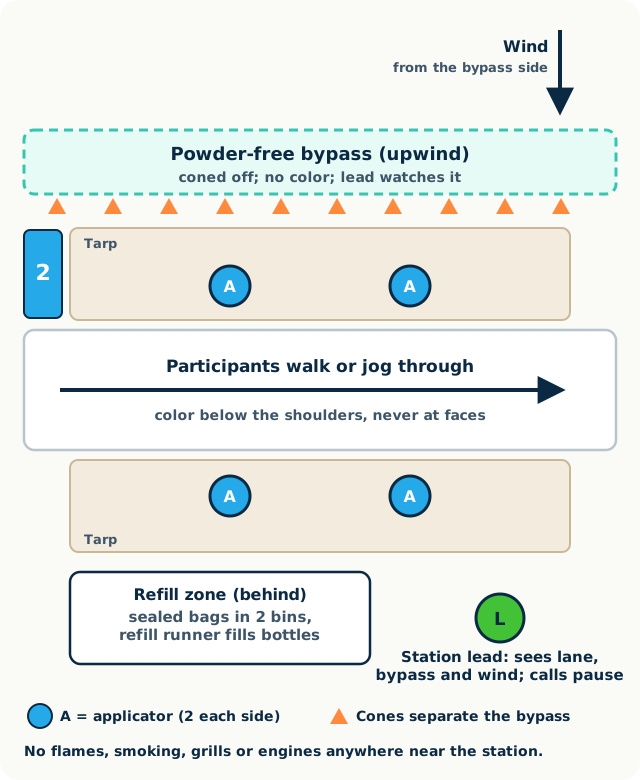
- The lane. Plan on a coned lane about 3 to 4 meters (10 to 13 feet) wide and about 10 meters (30 feet) long. That is wide enough for three or four children side by side, and long enough that nobody stops in the cloud.
- Tarps. One tarp or drop cloth on each side where applicators stand, extending under the lane edge. They catch most of the spilled powder and make cleanup a matter of folding them inward.
- Applicators. Two per side on both sides of the lane is our default, so four per station. Applicators stand still and let participants come to them. One side only halves the count and works for a small event.
- Bins. Two lidded bins or buckets per station, one behind each side's applicators, holding open powder and filled bottles or cups.
- The station lead. Stands at the entry end, facing oncoming participants. From there the lead can see the powder-free lane guide's signal, spot anyone who says stop, and watch the wind.
- Refill zone. Several meters behind the station, away from the lane. The refill runner opens sealed bags here, low to the ground, and closes them after every refill.
- A sign. A station number and color at the entry, so volunteers and first aid can say "station 3" on the radio.
The planner's printable station cards list these items for each station along with its position and powder share.
Dispensing methods compared
How color reaches participants changes the mess, the control and how fast a wave moves through. Pick one method per event if you can, so every applicator works the same way.
| Method | Throughput | Control | Mess and waste | Notes |
|---|---|---|---|---|
| Hand toss from a bin | Fast | Low; hard to keep below the shoulders | High | Cheapest. Needs firm briefing on aiming low. |
| Scoop or cup | Fast | Medium; a fixed amount each time | Medium | Volunteers at the Minisink Valley PTOs' color run in New York threw powder from cups. |
| Squeeze bottle | Medium; bottles need refilling | High; easy to aim at shirts and legs | Low | The easiest method to keep below the shoulders. Wide-mouth funnels speed up refills. |
| Packets handed to participants | Slow at the handoff | Low; participants throw at each other | High, plus packet litter | Better for a finale than for stations. Costs more per gram. |
Never use powered blowers, cannons or pressurized launchers to spread color. The Massachusetts State Fire Marshal's 2016 memo recommends banning cannons and powered devices that project powder over crowds, and keeping gas or electric equipment out of the powder area. Bowling Green State University's color run protocol allows hand-thrown powder only.
Wind, buildings and first aid placement
We found no official source that sets a wind-speed limit for color powder, so treat these as practical rules. Check which way the wind usually blows at your site at that time of day, and plan from there.
- Stations downwind of buildings, parking and doors. Powder can drift well past the station on a breeze. Keep it away from open windows, air intakes, playground equipment and cars.
- First aid and water upwind. The first aid table, its eyewash and the printed Safety Data Sheet should sit upwind of every station, close to the course but outside the cloud.
- Spectators upwind, too. Mark a viewing area upwind of the stations and the finish. Mark it with cones or tape so families with younger children know where to stand.
- Nothing hot or sparking nearby. No grills, smoking, generators or sound equipment near stations or stored powder. Put the music and any food trucks well away from the color.
- A pause rule. When wind carries powder toward buildings, cars or spectators, the station lead pauses color until it drops. Applicators wait with their bottles down while participants keep moving.
Designing the powder-free lane
The powder-free route uses the same course and earns the same recognition, without color. There are two ways to build it.
- A bypass at each station. A coned path 3 to 5 meters to the upwind side of each station, rejoining the course after it. This is the simplest option, and it keeps powder-free participants running with their class.
- A separate wave. Powder-free participants run first, before any color is used, or in a wave where applicators stand down entirely. This is the cleanest option for participants with asthma or sensory needs.
Either way, a powder-free lane guide walks with those participants and raises an agreed signal at each station so applicators lower their bottles. Plan the lane even if no one has asked for it yet, because requests often arrive in the final week. Our page on inclusive and powder-free options covers sensory-friendly waves and alternatives to powder.
The finale zone
A finale is optional. If you hold one, choose an open grass area away from buildings, cars and drains, and well away from the first aid table. Have everyone face away from the wind before the countdown, so the cloud blows off their backs rather than into their faces. Participants on the powder-free route and anyone who prefers to skip the finale watch from the upwind side.
Launch a finale by hand only, with thrown packets or cups. Do not use blowers, cannons or pressurized devices. Keep the crowd in a loose circle rather than a packed block, and give younger children the option to watch.
Set up inflatables, bounce houses and water slides before the first station or well away from the color. Powder clings to wet and vinyl surfaces, and rental companies may charge for cleaning.
Water, first aid and marshal points
Put the water station just past the finish, where participants naturally slow down, with a second one at the halfway point on longer routes. On a loop, one water table near the start and finish line serves every lap.
Place course marshals at every turn, every point where the course crosses a path or driveway, and wherever spectators might step onto the course. On the example loop, the planner allows four marshals. Streets need more, plus whatever traffic control the city requires. The dust-off area, where participants brush off before going indoors or into cars, belongs near the exit, on grass and away from drains. Stock it with towels and soft brushes rather than blowers. Our event-day plan covers how to run it.
Worked layout: a 400-meter school loop
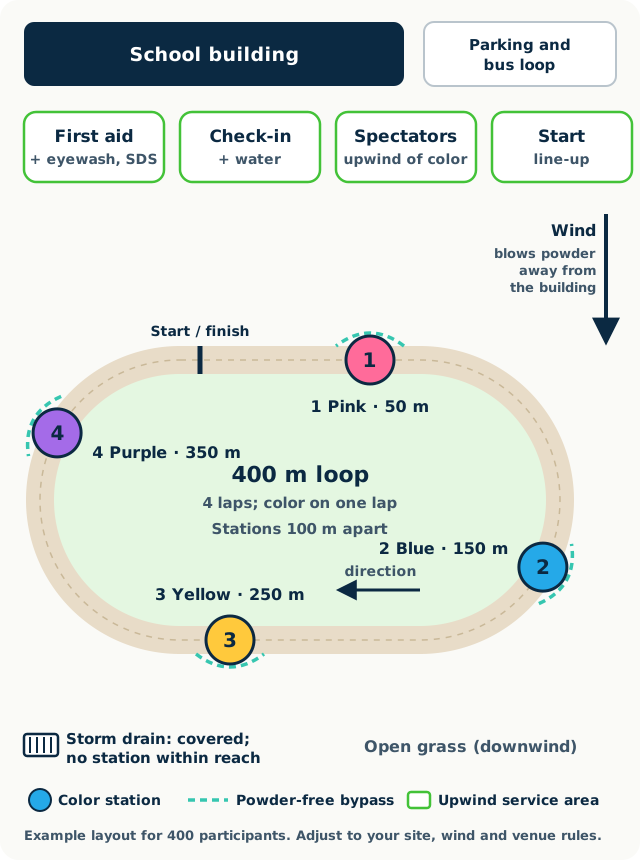
Example This is the example event we use across this section: 400 participants on a 400-meter loop, four laps each, color on one lap, four stations with two applicators on each side. These are the planner's default figures, not a recommendation for your site.
| Position on the loop | What goes there |
|---|---|
| 0 m | Start and finish line, wave marshals, water, lap counters if pledges are per lap |
| 50 m | Station 1: 4 applicators, 2 tarps, 2 bins, about 23 kg (51 lb) of powder |
| 150 m | Station 2: same setup |
| 250 m | Station 3: same setup |
| 350 m | Station 4: same setup |
| Upwind of the loop | First aid and eyewash table, spectator area, powder-free bypass at each station |
| Near the exit, on grass | Dust-off area and finale zone, if you hold one |
Arithmetic Spacing: 400 ÷ 4 = 100 m, so stations sit at the midpoints 50, 150, 250 and 350 m. Powder: 400 participants × 4 dustings × 50 g = 80 kg, plus a 15% buffer = 92 kg (about 203 lb), or 23 kg per station. Timing: four laps is 1.6 km, about 16 minutes at a 10-minute-per-kilometer walking and jogging pace. Four waves of 100 starting six minutes apart finish about 34 minutes after the first start.
Published guidance on powder per person ranges widely, from a couple of ounces per person in one fundraising guide to a pound or more in supplier calculators, so compare the planner's 50 g per dusting with what your supplier recommends. Our guide to color run supplies and powder explains why the figures disagree.
Draw the final layout on a printed aerial photo or a hand sketch, mark the wind direction, drains, first aid and the powder-free bypass, and give a copy to every station lead. The same course logic applies to a plain fun run without powder; our walk-a-thon planning resources cover lap courses and marshals for those events.
Sources
- Queanbeyan East Public School P&C, P&C colour run update (Mar 30, 2022). queanbeyae-p.schools.nsw.gov.au (accessed October 20, 2026)
- Washington State Department of Ecology (hosted by Kitsap County), BMP S436: BMPs for Color Events, 2024 Stormwater Management Manual for Western Washington (Pub. 24-10-013). kitsap.gov (accessed October 20, 2026)
- Minisink Valley Central School District, MV Color Fun Run (Oct 27, 2023). minisink.com (accessed October 20, 2026)
- Massachusetts State Fire Marshal, Colored powder memo (Apr 4, 2016). mass.gov (accessed October 20, 2026)
- Bowling Green State University Office of Risk Management, Color Run Safety and Protocol (Aug 11, 2016). WWW.BGSU.EDU (accessed October 20, 2026)
Frequently asked questions
Can a color run go through a parking lot or bus loop?
It can, but keep stations off it. Asphalt in a parking lot is usually crossed by storm drains, and any parked cars nearby will collect drifting powder. Use the lot as part of the route if facilities agree, close it to vehicles for the whole event including cleanup, cover the drains, and put the color stations on grass alongside it. Move staff cars to another lot the day before.
Should younger children run a shorter course?
Often, yes. Kindergarten through second grade can run two laps instead of four on the same loop, with color on one of them, and they get the same experience. Some schools give the youngest grades a lighter dusting or color only at the end. Keep the stations and spacing the same for everyone, so volunteers don't need a second set of instructions.
Do we need to mark the course the day before?
Set up cones, signs and tarps the day before if the site is secure and the forecast is dry, so event morning is only for powder, water and first aid. Leave powder in sealed bags in a dry, locked room away from heat until the morning of the event. If the site is open to the public overnight, mark positions with flags or chalk the day before and place everything on the morning.
Can we add obstacles to the course?
Yes, and middle schools in particular like them. Keep obstacles on grass, away from the color stations, so participants never crawl or climb through settled powder. Powder makes surfaces slippery, so avoid anything that needs grip, such as slides or balance beams, after the first station. Give each obstacle its own volunteer, and keep a route around it for anyone who prefers to skip it.