
Color run course and station planner
Plan station spacing, powder, volunteers and waves. Pre-filled numbers are starting assumptions for a 400-participant school event on a 400-meter loop. Ask your powder supplier how much they recommend and enter that.
No powder-free participants entered. Plan the lane anyway: requests often come in during the last week.
How the powder total was calculated
- 400 participants in color × 4 station passes each = 1,600 passes
- 1,600 × 50 g per pass = 80 kg, plus 15% buffer = 92 kg
- Total 92 kg (202.83 lb)
Station plan
| Station | Position | Powder | Applicators | Tarps | Bins |
|---|---|---|---|---|---|
| 1 | 50 m from start | 50.7 lb (23.0 kg) | 4 | 2 | 2 |
| 2 | 150 m from start | 50.7 lb (23.0 kg) | 4 | 2 | 2 |
| 3 | 250 m from start | 50.7 lb (23.0 kg) | 4 | 2 | 2 |
| 4 | 350 m from start | 50.7 lb (23.0 kg) | 4 | 2 | 2 |
Volunteer roles
| Role | People |
|---|---|
| Station leads | 4 |
| Applicators | 16 |
| Refill runners | 4 |
| Start and wave marshal | 2 |
| Finish and water | 3 |
| First aid and eyewash (adult with first aid training) | 2 |
| Powder-free lane guide | 1 |
| Course marshals at turns and crossings | 4 |
| Cleanup crew (after the event) | 8 |
| Total | 44 |
Wave schedule
| Wave | Starts | Finishes about |
|---|---|---|
| 1 | Start | +16 min |
| 2 | +6 min | +22 min |
| 3 | +12 min | +28 min |
| 4 | +18 min | +34 min |
Volunteer counts are planning rules of thumb: one lead and one refill runner per station, plus the applicators you set; lap counters only when pledges are per lap. Adjust to your venue.
Color station 1
Position: 50 m from the start on each lap. Powder for the event: about 50.7 lb.
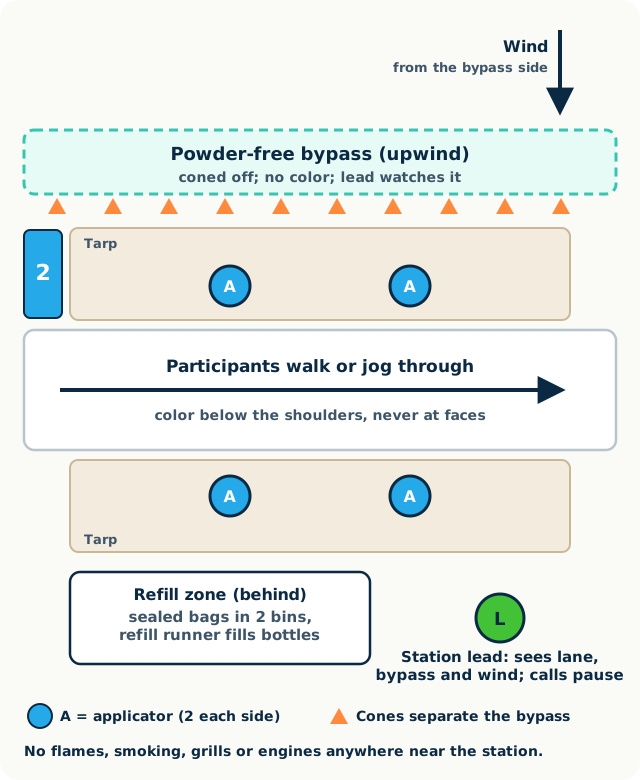
- Aim below the shoulders. Never at faces, and stop for anyone who says stop, covers their face or turns away.
- Nobody in the powder-free lane gets color. Lower your bottle when they pass.
- Pause when wind carries powder toward buildings, cars or spectators.
- No flames, smoking, grills, sparklers, fireworks or gas-powered equipment near powder. Keep bags sealed, dry and away from heat until needed.
- Powder in someone's eyes: walk them to first aid to rinse with clean water.
- After the last wave: sweep dry powder onto the tarps and bag it. No blowers. No hoses or pressure washers on paving unless facilities collects all the water for the sanitary sewer. Nothing into drains.
Lead: ____________ Applicators: 4 Refill runner: ____________
Color station 2
Position: 150 m from the start on each lap. Powder for the event: about 50.7 lb.
- Aim below the shoulders. Never at faces, and stop for anyone who says stop, covers their face or turns away.
- Nobody in the powder-free lane gets color. Lower your bottle when they pass.
- Pause when wind carries powder toward buildings, cars or spectators.
- No flames, smoking, grills, sparklers, fireworks or gas-powered equipment near powder. Keep bags sealed, dry and away from heat until needed.
- Powder in someone's eyes: walk them to first aid to rinse with clean water.
- After the last wave: sweep dry powder onto the tarps and bag it. No blowers. No hoses or pressure washers on paving unless facilities collects all the water for the sanitary sewer. Nothing into drains.
Lead: ____________ Applicators: 4 Refill runner: ____________
Color station 3
Position: 250 m from the start on each lap. Powder for the event: about 50.7 lb.
- Aim below the shoulders. Never at faces, and stop for anyone who says stop, covers their face or turns away.
- Nobody in the powder-free lane gets color. Lower your bottle when they pass.
- Pause when wind carries powder toward buildings, cars or spectators.
- No flames, smoking, grills, sparklers, fireworks or gas-powered equipment near powder. Keep bags sealed, dry and away from heat until needed.
- Powder in someone's eyes: walk them to first aid to rinse with clean water.
- After the last wave: sweep dry powder onto the tarps and bag it. No blowers. No hoses or pressure washers on paving unless facilities collects all the water for the sanitary sewer. Nothing into drains.
Lead: ____________ Applicators: 4 Refill runner: ____________
Color station 4
Position: 350 m from the start on each lap. Powder for the event: about 50.7 lb.
- Aim below the shoulders. Never at faces, and stop for anyone who says stop, covers their face or turns away.
- Nobody in the powder-free lane gets color. Lower your bottle when they pass.
- Pause when wind carries powder toward buildings, cars or spectators.
- No flames, smoking, grills, sparklers, fireworks or gas-powered equipment near powder. Keep bags sealed, dry and away from heat until needed.
- Powder in someone's eyes: walk them to first aid to rinse with clean water.
- After the last wave: sweep dry powder onto the tarps and bag it. No blowers. No hoses or pressure washers on paving unless facilities collects all the water for the sanitary sewer. Nothing into drains.
Lead: ____________ Applicators: 4 Refill runner: ____________
The planner works out four things organizers usually guess at: where stations sit on the course, how much powder to order, how many volunteers each station needs, and how long the event runs. It shows its arithmetic, so you can check every number against your supplier's advice and your venue.
How the powder total is calculated
- Participants in color = participants − those on the powder-free route.
- Passes per participant = stations × laps with color. On a one-way route, each station is passed once.
- Station powder = participants in color × passes × grams per dusting, plus your buffer (15% by default) for spills, wind and refills.
- Finale powder = participants in color × finale packets each × grams per packet. Set packets to None if you are not doing a finale.
- Total = station powder + finale powder, shown in pounds and kilograms, and split evenly across stations.
Arithmetic The pre-filled example: 400 participants × 4 stations × 1 lap with color × 50 g = 80 kg, plus 15% = 92 kg (about 203 lb), or about 51 lb per station.
Why published powder advice disagrees
Powder sellers' guidance ranges from a couple of ounces per person to a pound or more, a spread of roughly tenfold or more. The difference is not a mistake by one of them. It reflects how many stations a participant passes, whether volunteers dust from squeeze bottles or throw handfuls, whether there is a finale toss, the age of the participants, and how saturated you want shirts to look. A school event that colors each child once at four stations needs far less than an adult race that ends with everyone emptying a packet.
The planner's default of 50 g per dusting at four stations gives 200 g per participant, which matches the figure one powder supplier publishes for primary-school color runs, in an FAQ hosted by Coolum State School. The same supplier lists 200 to 250 g for high school and 400 g for adult events. Treat it as a starting point. Enter the amount your own supplier recommends and compare. The color powder buying guide explains the trade-offs and includes our dated price check.
Station spacing and the course
On a loop, the planner spaces stations evenly and places the first one half a gap from the start, so nobody is colored before the start line clears. On a one-way route, it divides the route into equal parts and leaves the finish clear. For the example 400 m loop with four stations, stations sit 50, 150, 250 and 350 m from the start, 100 m apart.
The planner warns when stations are closer than 40 m, a rule of thumb rather than a published standard. Closer than that, powder from neighboring stations tends to drift together into one long cloud, which is harder on eyes and breathing and gives volunteers no clean air between stations. Wind direction matters as much as spacing: the course and color station guide covers where to place stations relative to buildings, parking, drains and the first aid table.
Volunteer counts
The volunteer table uses rules of thumb you can adjust:
| Role | Rule used | Example (400 participants) |
|---|---|---|
| Station leads | 1 per station | 4 |
| Applicators | Stations × sides × applicators per side | 16 |
| Refill runners | 1 per station | 4 |
| Start and wave marshals | 2 | 2 |
| Finish and water | 1 per 150 participants, at least 2 | 3 |
| First aid and eyewash | 1, or 2 over 300 participants | 2 |
| Powder-free route guide | 1 | 1 |
| Course marshals | 2 per km of total course, at least 2 | 4 |
| Cleanup crew | 2 per station, at least 4 | 8 |
| Lap counters | Only on multi-lap loops with per-lap pledges | 0 (4 if per lap) |
| Total | 44 |
With flat gifts, the planner's default, the example needs 44. Turn on per-lap pledges and it adds four lap counters, for 48. When you are short, cut a station before you cut a safety role: first aid, the powder-free route guide and station leads should be filled first. The color run volunteer guide has role descriptions and a briefing script.
Waves and total time
Participants start in waves so stations never face a crowd. Total time = the last wave's start + the time one participant takes to finish the course. The course time is the total distance × your pace. For the example, four waves of 100 start six minutes apart, and each takes about 16 minutes to walk 1.6 km at 10 minutes per km, so the last wave finishes about 34 minutes after the first starts. Add time for the welcome, the finale and dusting off before anyone goes indoors.
Printable station cards
"Print station cards" prints one card per station with its position, its share of the powder, and the station rules every applicator follows: color below the shoulders and never at faces, stop for anyone who says stop, no color on the powder-free route, pause when wind carries powder toward people or buildings, no flames, smoking, grills, sparklers, fireworks or gas-powered equipment anywhere near powder, powder stored sealed, dry and away from heat, and dry cleanup with nothing washed toward drains. The reasoning behind each rule is on the color powder safety page. For printed role cards for every volunteer, use the download below.
- Volunteer cardsStation lead, applicator, refill runner, powder-free route guide, first aid and cleanup.Download PDF
Nothing you enter is saved or sent. For walking events without powder, the walk-a-thon volunteer planner estimates staffing the same way, and our walk-a-thon resources cover course setup and lap counting.
Sources
- Powder supplier's FAQ, hosted by Coolum State School, FAQs for Colour Powder Event. coolumss.eq.edu.au (accessed October 20, 2026)
Frequently asked questions
Should we color on every lap?
Usually not. Coloring every lap multiplies powder use and puts more powder near faces. Coloring one lap, or only the final lap, keeps powder use down and lets the earlier laps count for pledges. If you do color several laps, lower the grams per dusting. The planner warns when a participant would pass a station more than 12 times.
How much powder goes on one person at one station?
It depends on the method. A gentle squeeze from a bottle puts down less than a thrown handful. The planner defaults to 50 g per dusting as a planning number. To check it, weigh what one volunteer actually puts down in a practice squeeze or toss, then enter that figure. Ask your supplier what they assume.
Do volunteers need to be on both sides of the lane?
Both sides color shirts more evenly and keep the line moving, which is why the planner defaults to it. One side works for narrow paths, for small events, and where wind would blow powder from one side onto spectators. Set "Applicators stand on" to one side and the planner recalculates volunteers.